|
|
|
Nature of the Child
The work of the elementary age child, as in earlier stages, is development of the intellect and personality through exploration and discovery of the environment. The child builds abstraction through action on the concrete. Throughout the years from 6 to 12 the child will grow in the ability to reason. The growing powers of reason, with its ability to recognize possibilities, fuels the imaginative and enthusiastic queries that are a marker of this developmental stage. Less egocentric now, and possessing a developing social and moral sense, the child is becoming a contributing member of the social order.
|
|
Goals
The work of the child at an earlier stage of development was the formation of the individual. The work of the elementary age child is the formation of a responsible social being. This personal responsibility is grounded in an understanding of the individuals place in the natural order and is achieved through freedom of choice and concentration on meaningful work.
Curriculum
The Montessori elementary curriculum, often entitled "Cosmic Education," is designed to give the child a view of the interdependency of the Natural Order. Through self-motivated inquiry, the child is encouraged to discover natural laws. Students work in the areas of physical and life sciences, the study of geography and culture. Mathematics and language curriculums provide for the development of skills necessary to exploration, discovery and communication. The emphasis on internal and external order leads to logical thinking as a base for creativity.
|
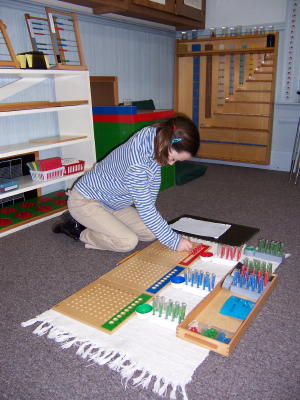
Long Division |
The practical life curriculum gives the child responsibility for the care of the indoor and outdoor environments. It provides for individual and group planning and problem solving. A sense of social responsibility, pride and high self esteem are the results of the child's participation in classroom maintenance and management. |
|
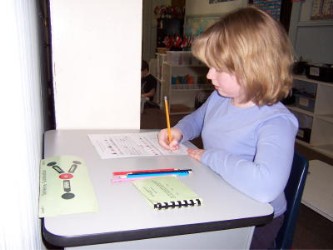
Sentence Analysis
|
The Classroom
The Montessori class is a working community of children and adults. The ages of the students usually encompass a three year span to encourage peer learning and provide for individual differences.
The classroom's layout allows for a view of the curriculum at a glance. Earth history, political geography and culture are grouped together with the life sciences adjoining. Language is given its own area as are mathematics and geometry.
The outdoor environment is an extension of the elementary classroom. The larger
|
| community is part of the "going out" experience. Through curriculum related field trips the 6-12 year old child views the world as his classroom.
Materials
Throughout the years from 6 to 12 the child will build abstraction through use of concrete manipulatives. These manipulatives or materials are embodiments of concepts to be discovered through active manipulation by the child. The materials are either manufactured traditional Montessori materials, or are created by teachers according to general guidelines to meet the needs of a science based curriculum. Use of the materials engages the child visually, auditorally and kinesthetically.
|
|
Teacher
The Montessori teacher is a facilitator or guide. Versed in child development and the curriculum, the teacher observes to determine individual interests and learning styles. The teacher prepares the environment to meet the needs of the individual and the group. The teacher gives individual and group lessons, oversees group planning and problem solving, develops materials and confers with parents. Our teachers' enthusiasm and interest in every class member encourages every child to make the best effort.
|
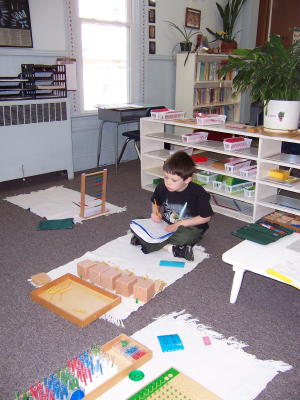
Golden Bead Division |
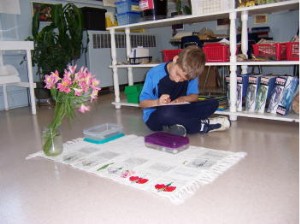
Parts of the Flower |
|
|